Taksim'i Bırakıp Kıyıya Geçtiler: Dijital Göçebelerin Beylikdüzü Keşfi
Walk through Taksim on any given Tuesday and you'll feel it immediately — the relentless hum of tour groups, the overpriced espresso, the Wi-Fi that cuts out right when your Zoom call matters most. For years, remote workers arriving in Istanbul defaulted to the obvious neighborhoods: Taksim, Karaköy, Cihangir. They were the "safe bets." Familiar, Instagram-ready, full of other foreigners doing the exact same thing.
But something has shifted. Quietly, without a viral TikTok moment or a Nomad List surge, Beylikdüzü — Istanbul's waterfront district sitting about 35 kilometers west of the city center — has become the destination that digital nomads whisper about to each other.
We talked to people who've made the move. What we heard surprised us.
"I Didn't Even Know It Existed Until Month Three"
Ashley Reeves, a 31-year-old UX designer from Portland, Oregon, spent her first three months in Istanbul rotating through Airbnbs in Şişli and Beyoğlu. "I was burning through money faster than I expected," she says. "A decent apartment near Istiklal was running me $1,100 a month, and that wasn't even a nice place."
A Turkish coworker — she was doing contract work for an Istanbul-based design agency — mentioned Beylikdüzü almost offhandedly. "She described it like it was obvious. Like, 'Why are you paying that much when you could live by the sea for half the price?' I honestly thought she was exaggerating."
She wasn't. Ashley found a furnished one-bedroom apartment with a partial Marmara Sea view for the equivalent of roughly $550 a month. The building had fiber internet. There was a tram stop two blocks away.
"The first morning I walked to the waterfront promenade with my coffee, I genuinely teared up a little. It felt like I'd been scammed by the idea of what Istanbul was supposed to be."
The Numbers Don't Lie
For US readers doing the math, the cost comparison between Beylikdüzü and Istanbul's central expat hubs is striking. A mid-range furnished apartment in Cihangir or Karaköy typically runs between $900 and $1,400 per month right now, depending on the season and the dollar-to-lira exchange rate. In Beylikdüzü, comparable — often larger — spaces clock in between $450 and $750.
Groceries tell a similar story. The neighborhood's local markets and weekly bazaars offer produce, dairy, and staples at prices that feel almost absurdly affordable to anyone coming from a major American city. A full week of groceries for one person? Easily under $30 if you shop like a local.
Internet reliability, which is the non-negotiable for any remote worker, is genuinely solid here. Fiber infrastructure has expanded significantly across the district over the past few years, and most residential buildings now offer connection speeds that comfortably handle video calls, cloud uploads, and the rest of the remote work toolkit. Several co-working spaces have also opened along the main commercial corridors, offering day passes and monthly memberships for those who need a dedicated workspace outside the apartment.
What Taksim Can't Offer
The lifestyle gap isn't just financial. Remote workers who've settled in Beylikdüzü consistently describe something harder to quantify: the feeling of actually living somewhere rather than just visiting it.
Marco Ferretti, a freelance developer from Chicago who's been based in Beylikdüzü for eight months, puts it bluntly. "In Karaköy, every café is performing for tourists. The menu has English first, Turkish second. Everyone assumes you don't speak the language, and honestly, after a while, you stop trying to learn it because you don't need to. Here, you need to engage. The guy at the bakery, the woman at the pharmacy — they're patient with you, but they're not catering to you. It forces you to actually participate in the place."
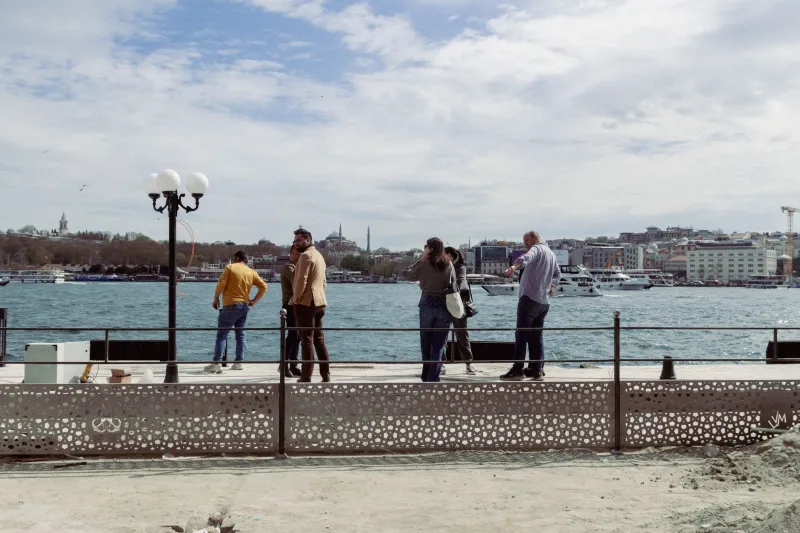
That participation, according to long-term residents, is what turns a stint in Istanbul into something more meaningful. The waterfront promenade — a long, well-maintained stretch along the Marmara coast — functions as the neighborhood's living room. Evenings bring out families, elderly couples doing their daily walk, teenagers on bikes, and yes, an increasing number of laptop-carrying foreigners who've figured out that this is where real life happens.
The Community Is Building Itself
There's no formal expat club in Beylikdüzü. No weekly meetup at a designated bar, no Facebook group with 40,000 members and daily posts about visa runs. What exists instead is something more organic — a loose network of people who found each other through coincidence, shared cafés, and the simple fact that there aren't that many of them yet.
"We have a WhatsApp group now," Ashley laughs. "There are maybe 25 people in it. Someone shares a good restaurant, someone asks about getting a SIM card, someone needs a recommendation for a dentist who speaks English. It's low-key. I actually prefer it that way."
That low-key quality seems to be part of the appeal rather than a limitation. Several nomads mentioned that the absence of a saturated expat scene means they've built more genuine friendships with Turkish neighbors and colleagues than they ever managed in Istanbul's tourist-heavy center.
The Trade-Off Is Real
Fairness demands acknowledging the downsides. Beylikdüzü is not Istanbul's cultural core. The nightlife scene is quieter. Access to the city's major museums, concert venues, and the Grand Bazaar requires a commute — the Metrobüs line connects the district to the center, but it's a 45-to-60-minute ride depending on traffic and time of day.
For nomads who want to be in the thick of Istanbul's historic neighborhoods every single day, Beylikdüzü will feel like a compromise. But for those who've realized they don't actually need that proximity on a Tuesday afternoon when they're deep in a work sprint, the trade-off starts to look less like a sacrifice and more like a deliberate choice.
"I go into the city maybe twice a week," Marco says. "I see more of Istanbul now than I did when I lived there, because now it's a trip I choose to make. It means something."
That shift in perspective — from Istanbul as a backdrop to Istanbul as a destination you visit from your actual home — might be the most honest description of what Beylikdüzü offers. Not a substitute for the city. A better base from which to actually enjoy it.